At studioNWA we are designing some of the most cutting edge data centres in the world. Our specialists collaborate with our clients to provide creative, designs that are ground breaking, robust, energy efficient and considerate to the environment. We deliver reliable and adaptable solutions for our clients to suit their requirements - present and future. And we have been doing so since the practice was established in 2002. We are committed to pushing the boundaries of design. With our expertise and passion for excellence, we have earned a reputation for delivering reliable, innovative, and environmentally conscious solutions.
Discover moreFlow-Flow message: Stream with specified ID not found or no feeds were added to stream
studioNWA is committed to a carbon management plan to reduce operational carbon emissions, in line with the UK and global Net Zero target by 2050 to limit the effects of climate change.
The framework:
Scope 1 is defined as direct emissions from the combustion of fuel in assets a company operates.
How we are improving – The Old Dairy – our office building in Redbourn- is equipped with an underfloor system for space heating needs. Due to its semi-rural location, the property is not
connected to a natural gas network and relies on an LPG tank to fuel a boiler.
Since 2019, our baseline reporting year, we have managed to reduce our CO2 emissions from heating by 36% by investing in maintenance to the underfloor heating and boiler. We have also
adjusted our thermostat and sealed drafts to further reduce unnecessary heat loss.
Next steps – installation of an air source heat pump to decarbonise our heating supply, replacing LPG gas combustion on site for electricity.
Scope 2 refers to indirect emissions from the generation of energy purchased from a utility provider.
How we are improving – since we began monitoring our electricity consumption, we have become more rigorous about light switches being turned off after meetings and in office areas not being occupied. Sensors have been installed in the kitchen and toilets. A post-pandemic hybrid work mode requires PCs being left on for longer periods of time, which reflects in the 6% electricity use increase in 2022, also attributed to additional IT equipment due to growing staff numbers. Mitigation measures are in place, such as energy saving monitors and switch-off schedules when possible. We also continue to benchmark Electricity Use Intensity (EUI) in kWh/m2 against CIBSE’s Database for similar office typologies in both typical and good practice consumption scenarios.
Next steps – proposal for a roof mounted solar panel system to go through planning to seek consent for on-site renewable energy production, reduce reliance on the national grid and associated CO2 emissions.
Scope 3 includes indirect emissions from transport, purchase of goods, business travel and other relevant upstream and downstream emissions.
How we are improving – commuting to the office plays a big role in our operational carbon emissions, as our semi-rural location is not accessible by public transport.
One of the lessons learned from the Covid-19 pandemic was that our business was able to adjust to remote working conditions and continued to thrive. A lesson that we took on board as we continue to operate in hybrid mode, reducing the number of car trips to the office and in some cases allowing staff to work remotely from international posts on a permanent basis.
Commuting flexibility has translated into a 51% reduction of carbon emissions from miles travelled when compared to 2019, our baseline year.
We also encourage video calls for meetings and prioritise travel by rail rather than flying.
Next steps – the installation of electrical vehicles charging stations to promote a cleaner mode of transport to the office.
To extend the monitoring of Scope 3 emissions to business travel, hotel stays, waste and other relevant categories.
studioNWA se ha comprometido a aplicar un plan de gestión del carbono para reducir las emisiones operativas de carbono, de acuerdo con el objetivo británico y mundial Net Zero para 2050, con el fin de limitar los efectos del cambio climático.
El marco:
El Alcance 1 se define como las emisiones directas procedentes de la combustión de combustible en los activos que explota una empresa.
Cómo estamos mejorando – The Old Dairy -nuestro edificio de oficinas en Redbourn- está equipado con un sistema de suelo radiante para las necesidades de calefacción. Debido a su ubicación semirrural, la propiedad no está
conectada a una red de gas natural y depende de un depósito de GLP para alimentar una caldera.
Desde 2019, año de referencia de nuestro informe, hemos conseguido reducir nuestras emisiones de CO2 procedentes de la calefacción en un 36% invirtiendo en el mantenimiento de la calefacción por suelo radiante y la caldera. También hemos ajustado el termostato en
y sellado las corrientes de aire para reducir aún más la pérdida innecesaria de calor.
Próximos pasos: instalación de una bomba de calor aerotérmica para descarbonizar nuestro suministro de calefacción, sustituyendo la combustión de gas GLP in situ por electricidad.
El Alcance 2 se refiere a las emisiones indirectas procedentes de la generación de energía comprada a un proveedor de servicios públicos.
Cómo estamos mejorando: desde que empezamos a controlar nuestro consumo de electricidad, somos más rigurosos a la hora de apagar los interruptores de la luz después de las reuniones y en las zonas de la oficina que no están ocupadas. Se han instalado sensores en la cocina y los aseos. Un modo de trabajo híbrido pospandémico requiere que los PC permanezcan encendidos durante más tiempo, lo que se refleja en el aumento del 6% del consumo eléctrico en 2022, también atribuido a equipos informáticos adicionales debido al aumento de la plantilla. Existen medidas de mitigación, como monitores de ahorro energético y horarios de desconexión cuando es posible. También seguimos comparando la Intensidad de Uso de la Electricidad (EUI) en kWh/m2 con la base de datos del CIBSE para tipologías de oficina similares, tanto en escenarios de consumo típico como de buenas prácticas.
Próximos pasos: la propuesta de un sistema de paneles solares montados en el tejado se someterá a planificación para obtener el consentimiento para la producción de energía renovable in situ, reducir la dependencia de la red nacional y las emisiones de CO2 asociadas.
El Alcance 3 incluye las emisiones indirectas del transporte, la compra de bienes, los viajes de negocios y otras emisiones relevantes anteriores y posteriores.
Cómo estamos mejorando: los desplazamientos a la oficina desempeñan un papel importante en nuestras emisiones de carbono operativas, ya que nuestra ubicación semirrural no es accesible en transporte público.
Una de las lecciones aprendidas de la pandemia de Covid-19 fue que nuestra empresa supo adaptarse a las condiciones de trabajo a distancia y siguió prosperando. Una lección que asumimos, ya que seguimos funcionando en modo híbrido, reduciendo el número de desplazamientos en coche a la oficina y, en algunos casos, permitiendo que el personal trabaje a distancia desde puestos internacionales de forma permanente.
La flexibilidad en los desplazamientos se ha traducido en una reducción del 51% de las emisiones de carbono derivadas de los kilómetros recorridos en comparación con 2019, nuestro año de referencia.
También fomentamos las videollamadas para las reuniones y damos prioridad a los viajes en tren frente a los vuelos.
Próximos pasos: instalación de estaciones de carga de vehículos eléctricos para fomentar un modo de transporte más limpio a la oficina.
Ampliar el seguimiento de las emisiones de Alcance 3 a los viajes de empresa, las estancias en hoteles, los residuos y otras categorías relevantes.
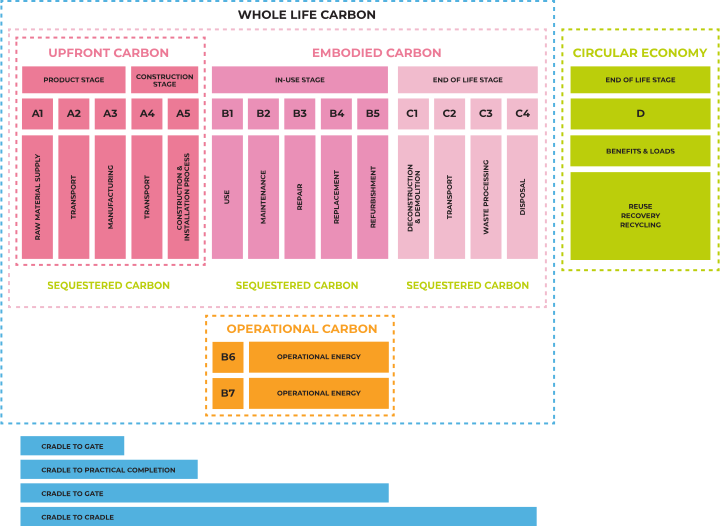
Embodied carbon represents the accumulative emissions a particular material or product generates throughout its lifetime, from manufacturing stage to installation during construction, maintenance and disposal at its end of life.
Classified as critical infrastructure buildings, data centres are required to meet high levels of security, performance and insurance conditions, thus having to rely on traditional high performing, durable materials such as concrete, steel and aluminium – amongst the highest in embodied carbon content.
As material specifiers, we engage with stakeholders in the supply chain to stay up to date with advances to manufacturing processes of traditional materials and to encourage a growing portfolio of lower carbon alternatives. We analyse embodied carbon data from EPD certificates and prioritise reduced upfront carbon (A1-A5) and circularity whenever possible.
studioNWA has also developed ECMat, its own carbon management tool to produce project case studies and to benchmark embodied carbon of materials as we continue to improve our carbon-conscious spec.
Measure. Monitor progress. Push for change. That’s studioNWA‘s approach to advancing Net Zero.
Life Cycle Assessment Stages: BS EN 15978:2011
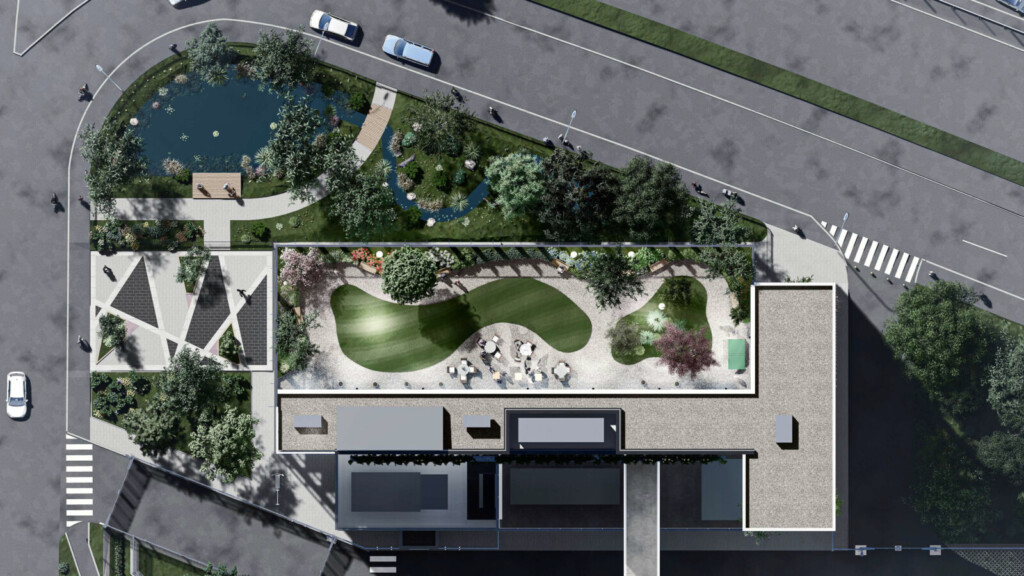
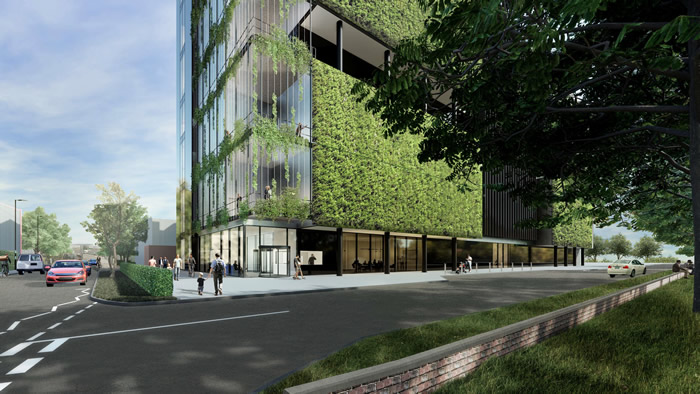
Urban greening has become more prevalent as a planning requirement in urban settings, where contributions can be made in the form of green roofs, green walls and amenity areas.
studioNWA engages with Local Planning authorities and specialists to identify the best solution for a given project site to mitigate heat island effect, air pollution, rainwater storm management and
contribute to on-site carbon capture, whilst meeting relevant policy targets.


BREEAM & LEED assessments are the leading and most widely adopted environmental assessment methods for data centre buildings today, often pursued at planning stage and to reinforce client’s ESG goals.
studioNWA’s in-house knowledge of these certification schemes allows us to work closely with our clients, sustainability consultants and wider design team to maximise the potential for architecturally-driven credits and meet project targets.
Implementation of green roof and walls for a number of benefits:
“Fabric first” approach optimises thermal performance of the building envelope to reduce energy use demands from the outset of the design process.
In data centre typologies, this methodology is particularly effective for the design of administration blocks, as daylighting and views out are an inherent requirement for office areas with permanent workstations, meeting rooms and amenity spaces.
Glazing ratios and solar shading devices designed to suit solar orientation ensure the building façade becomes more resilient to excessive heat gains and losses.
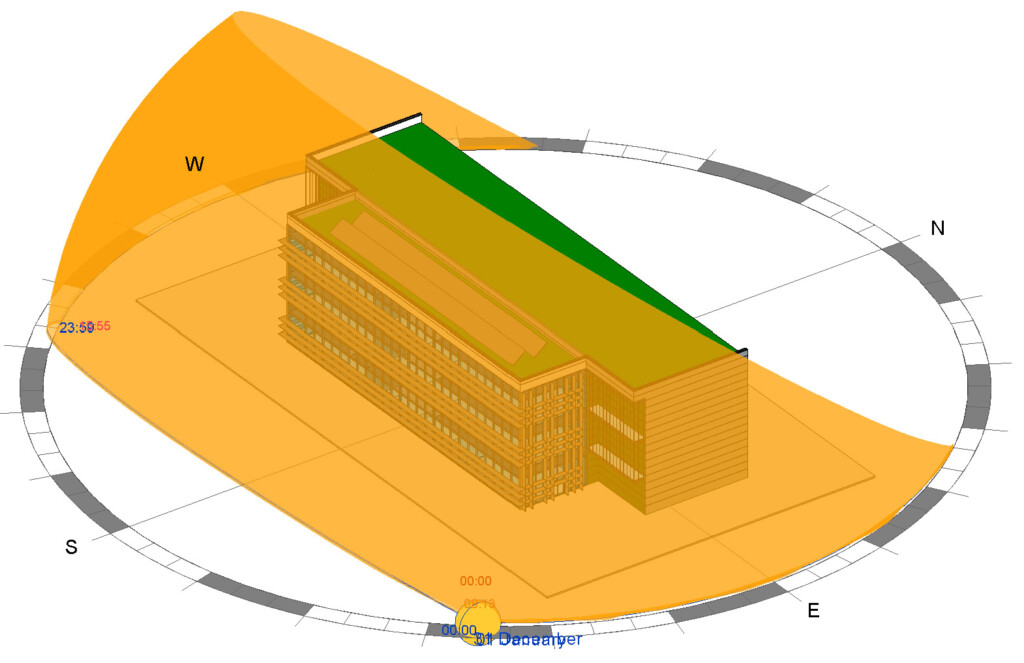
In addition, the optimisation of U-values in external walls, roofs and floors, and effective airtightness details result in a thermally efficient building envelope that reduces Energy Use Intensity (EUI) per square metre and associated carbon emissions.

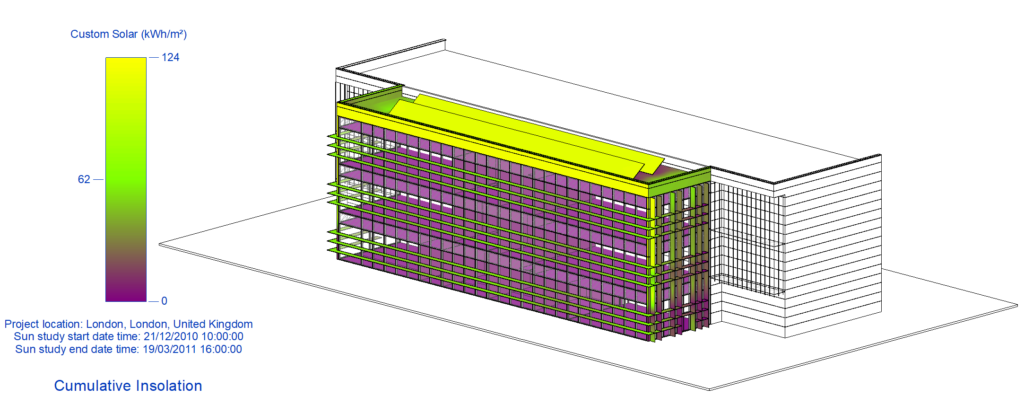
studioNWA continues to invest in its own sustainability capabilities, including software that can provide real-time design feedback on elements that affect thermal performance of the building fabric. Our design toolkit can also assist the team to identify optimal areas for the installation of solar panels, based on incident solar irradiation values on horizontal and vertical planes.
studioNWA’s early stage design approach facilitates coordination with other disciplines and alignment of energy model targets, contributing to reduction of energy consumption and associated carbon emissions.
studioNWA operates as an ISO 14001:2015 Certified practice, for the implementation of day-to-day actions that minimise our environmental impact. Key objectives include:
Certificate No: 326702019
Our CGI expertise contributes to the planning approval process by providing realistic representation which in turn reduces potential obstacles or delays.
From urban massing feasibilities, CGI site plans, photomontages, interior and exterior renders and interactive immersion experiences, the visual aspects of collaborative design progression can be assessed by our clients through every stage of the process.
Our in-house CGI team have a wealth of technical design knowledge and a strong architectural background which ensures accurate architectural renders.
Our CGI capabilities, linked to our BIM process, enable improved collaboration within the design team.
Producing our own CGIs helps our clients visualise the project’s appearance, layout, and details with incredible clarity throughout all stages of the process, and not just at the very end.
Our in-house CGIs allow greater customisation and flexibility – from assisted attention to detail to the ability to explore design options. An image is worth 1000 words.
Cost efficiency and Sustainable design. BIM can help us significantly improve the cost-efficiency of a project whilst allowing us to reduce the impact of buildings by enhancing our Fabric First approach. As well as calculating carbon emissions, we use BIM to reduce wastage, incorporate sustainable materials and improve efficiencies.
Better data management. As all parties are working from the same information – known as a “single source of truth”, the potential for mistakes is reduced. This not only enhances our efficiency and collaboration, but it also strengthens our data quality.
Improved quality assurance. We recognise BIM as a tool to aid decision making and reduce risks.
Better strategic planning. BIM gives us a strategic oversight across design, construction, and operations. It shows us where we can make efficiencies.
Stronger collaboration. With integrated workflows, information sharing, and review features BIM deeply strengthens collaboration. 77% of architects agree that BIM improves communication and understanding.
We manage and provide information according to our standards based on ISO 19650.